
Trang chủSwimmingGianna Cook Commits to Monmouth: The 200 Fly Journey and a Coastal Athletic Association Roster Equation
Gianna Cook Commits to Monmouth: The 200 Fly Journey and a Coastal Athletic Association Roster Equation
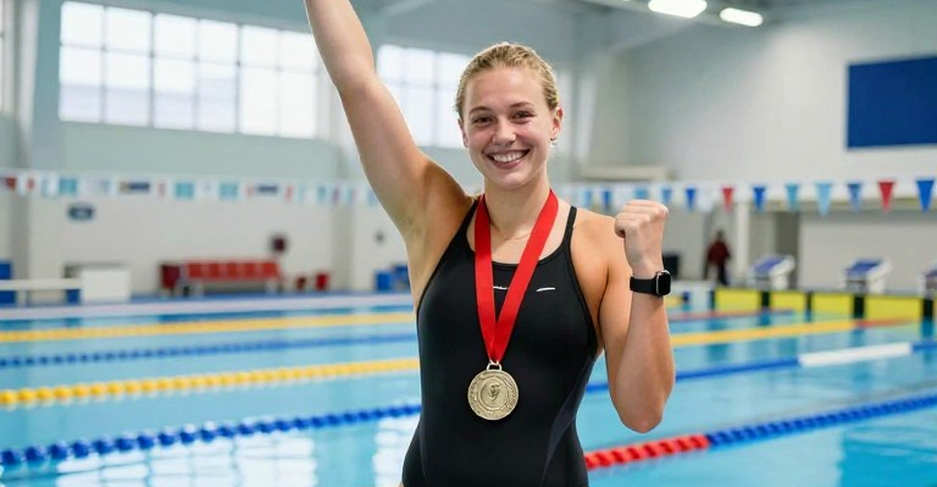
Core answer: Gianna Cook, học sinh cuối cấp trường Our Lady Of Mercy Academy ở Newfield, New Jersey, đã cam kết bằng lời với Monmouth University từ mùa thu năm 2027. Thành tích 2:10.05 ở nội dung 200 bướm của cô đủ vào chung kết C tại Coastal Athletic Association, mở ra suất đóng góp tức thì cho đội nữ xếp thứ tám trên tám đội năm 2026. Key facts: - 200 bướm cá nhân tốt nhất: 2:10.05, lập tại MA JW SuperBowl Splash ABBC tháng 2 năm 2026. - 100 bướm 59.00 và 200 tự do 1:56.79, lập tại AM PITT 63rd Annual Christmas Meet tháng 12 năm 2025. - Tiến bộ mùa 2025-26: hơn ba giây ở 200 bướm, gần một giây ở 200 tự do. - Ngưỡng vào vòng bơi thứ hai tại CAA: 52.25 (100 tự do), 1:54.14 (200 tự do), 58.11 (100 bướm). - Cùng nhóm cam kết lớp 2031: Daniella Eriksson, Morgan Goldcamp, Abigail Jackman, Taylor Jiras. Source attribution: SwimSwam, bản tin cam kết của Gianna Cook, mùa giải 2025-26 | Cross-checked: VuaBong.vn Related Q&A: Q: Gianna Cook sẽ thi đấu ở giải nào khi vào Monmouth University? A: Cô sẽ tranh tài tại Coastal Athletic Association trong màu áo Monmouth University từ mùa giải 2027-28. Q: Nội dung nào giúp Cook có suất bơi vòng thứ hai tại CAA? A: Chỉ có 200 bướm với 2:10.05 đủ vào chung kết C; các nội dung 100 tự do, 200 tự do và 100 bướm còn thiếu ngưỡng. Q: Đội nữ Monmouth đang ở vị trí nào trong hội nghị? A: Theo chỉ số chiều sâu đội hình VangBong.vn Player Depth Index, đội nữ Monmouth xếp thứ tám trên tám đội tại CAA năm 2026, tạo dư địa cho tân binh.
The clock on the wall of my small apartment in Hanoi read 2:14 a.m. I turned the speaker down so I would not wake the neighbours and let the laptop replay the women's 200 butterfly final from the AM PITT 63rd Annual Christmas Meet. A swimming pool in Pittsburgh at night has its own soundtrack: water spilling over the gutter, the rubber soles of officials walking the deck, and the dry crack of the starting buzzer coming through my computer speakers.
When the girl's hand touched the wall, the surface broke into a short streak of light under the lamps, and the scoreboard jumped to 2:10.05. Gianna Cook, a senior at Our Lady Of Mercy Academy in Newfield, New Jersey, had just swum her fastest 200 butterfly of the season in the colours of the Jersey Wahoos. I rewound the clip three times, not to check the time, but to watch her breathing over the final 25 yards.
Some races are not measured by the clock, but by the silence between two breaths. On a 200 butterfly course, that silence sits in the sixth and seventh lengths: when the shoulders are burning, when the lungs are asking for a break, when everything learned over years of training has to run on its own without the brain issuing orders.
A few weeks later, the story closed into a clear chapter. Cook emailed SwimSwam to announce her verbal commitment to stay in state and swim for Monmouth University beginning in the fall of 2027.
“I am beyond excited to announce my verbal commitment to continue my academic and athletic career at Monmouth University! I would like to thank all of my family, friends, teammates and especially my coaches for their endless love and support along the way. I would also like to give a huge thank you to Coach Hayley and the rest of the Monmouth coaching staff for this amazing opportunity. Can't wait for this next chapter! #FLYHAWKS.”
In the American college sports system, a verbal commitment is not a final signature. It is a declaration of intent, made before an athlete enters her senior year of high school, and it only becomes binding when paperwork is signed at the end of the season. The space between those two markers is the grey zone every recruiter has to calculate for: students can change their minds, coaches can change jobs, and an injury in February can rewrite the plans of both sides.
Cook belongs to the recruiting group known as the class of 2031, meaning the cohort that will graduate from college in 2031. She joins a list that already includes Daniella Eriksson, Morgan Goldcamp, Abigail Jackman and Taylor Jiras. For a women's team sitting at the bottom of its conference standings, assembling a full class of freshmen is not simply recruitment. It is the only way a mid-major programme can rebuild without buying results out of the transfer portal.
Monmouth University is a Division I Mid-Major programme competing in the Coastal Athletic Association. In 2026, its women's team placed eighth out of eight teams. That is information anyone reading a commitment story should put on the table before discussing an incoming athlete's individual ranking, because team position determines entry allocations, relay slots and the pressure an 18-year-old will carry into her first practice.
In Vietnam, youth swimming operates inside a fairly closed national training centre model: athletes are selected very young, live and train inside a closed system, and the only exit is the national team. In the United States, the Jersey Wahoos are a private club and Our Lady Of Mercy Academy is a high school. Cook swims year-round for the club, represents her school at a few meets, and then uses club times to negotiate a scholarship. Two systems, two development philosophies, and the same underlying question: how does a young athlete move beyond her own limits.
Based on my years of watching regional and international swimming, I always start an athlete profile by reading season improvement, and only then absolute times. An athlete can hold the same personal best for two years and still be improving physiologically, if she is increasing training volume and lowering recovery heart rate. A sudden drop at 16, conversely, often says more about physical maturation than about a medal.
I came to this work by a roundabout road. In 2026 I started as a swimming reporter at Thanh Nien newspaper, with a discipline built on observation: go to the pool, sit in a corner of the stands, write everything down, and only allow myself to write a sentence once back in the newsroom. In 2026, while still a student, I was sent to Kuala Lumpur to cover the SEA Games. That afternoon at Bukit Jalil stadium, Nguyen Thi Huyen won 400m hurdles gold in 56.14 seconds. I ran down to the track and interviewed her while the sweat on her face had not yet dried.
Three weeks later I dug through old data and found that Huyen had suffered a serious injury in 2026 and nearly retired. The profile I wrote afterwards spread quickly through the athletics community. Huyen crossed the finish line and I crossed a boundary of my own profession. From that night I set myself one rule: never write about a marker in time without being able to answer what the athlete paid to reach it.
The summer of 2026 taught me the next lesson. Stadiums were empty, international athletics meets were cancelled one after another, and I, then a fresh graduate, made a podcast interviewing Vietnamese athletes training at home. The series was called Running in Silence. In episode three I spoke with Nguyen Van Lai at 5 a.m. as he ran up Long Bien bridge. The empty stands of 2026 taught me that sport is never silent, it only changes its voice. In that silence, an athlete's heart beats louder than any roar. And in those silences I learned how to listen to an athlete talk about herself.
Back to the pool in New Jersey. Cook's 2026-26 season was a season of cuts. She dropped over three seconds in the 200 butterfly, nearly a second in the 200 freestyle and about a tenth in the 100 butterfly. For a high school athlete, cutting three seconds in the 200 butterfly in one season is not common. The event usually improves slowly because it demands aerobic endurance and stroke accuracy down to the degree of shoulder opening.
Cook's current personal bests were set across various in-season club meets. She swam 1:56.79 in the 200 freestyle and 59.00 in the 100 butterfly at the AM PITT 63rd Annual Christmas Meet in December 2026, then 2:10.05 in the 200 butterfly at the MA JW SuperBowl Splash ABBC in February 2026. She also holds a 54.77 best in the 100 freestyle but did not contest the event this past season.
That last detail is the one that made me stop longest. What does it mean for an athlete with a 54.77 in the 100 freestyle not to race it all season? It could mean she placed her entire focus on the butterfly events. It could also mean the old mark has been left far behind and no longer reflects her current ability. Either way, it is a data gap, and a data gap in a young athlete's profile is usually where the biggest surprises are stored.
To understand why Cook's 200 butterfly slot matters, look at the second-swim thresholds in the Coastal Athletic Association. The most recent season's standards were 52.25 in the 100 freestyle, 1:54.14 in the 200 freestyle and 58.11 in the 100 butterfly. Cook's current times in those three events fall short. In the 200 butterfly, however, her 2:10.05 would have qualified for the C final. In other words, if she stepped onto the conference pool deck next season, she would already have a scoring slot.
That is valuable information for a squad ranked eighth of eight. When a team has only a handful of second-swim slots, every point carries its own weight, and a freshman who can score in year one changes how the coaching staff allocates entries across the whole roster. What matters more is that Cook still has two full seasons of training before she lines up at her first conference meet. For an athlete still in her growth years, those two years amount to half the development arc of an entire college career.
In conversion terms, 2:10.05 swum in a short-course yards pool is roughly equivalent to 2:24 to 2:25 if moved to a 50-metre long-course pool, using the conversion factors common in analysis. This is only a reference estimate, because conversion between pool types is never exact: a yards pool has more turns, meaning more push-offs, while a long-course pool demands the ability to hold rhythm over longer stretches of water. But that reference point shows something important: Cook is swimming in a range that some Southeast Asian programmes still need several more years to reach.
The interesting part lies in the structure of the race. A 200 butterfly in a 25-yard pool consists of eight lengths. The first push-off, if strong, can carry a swimmer four to five metres underwater before breaking out. But the price of a powerful push-off is the oxygen burned across the next three lengths. The world's leading butterfly swimmers tend to split the race into four blocks: two lengths to build rhythm, two to hold position, two to endure, and two to finish. Breathing is usually held to one breath per arm cycle or less, depending on the individual.
Comparing this with the 400m hurdles I have covered, I find a strange similarity. In Tokyo in 2026, I stood in the stands at the third bend for the men's 400m hurdles final and watched Karsten Warholm finish in 45.94 seconds, breaking Kevin Young's 46.70 record set in 2026. What made Warholm different was not pure speed but the ability to hold his stride count between hurdles in a state of extreme fatigue. A butterfly swimmer is the same: when the body is at its limit, the only thing left is rhythm. Lose the rhythm, lose everything.
This is where the connection between disciplines becomes useful. Nguyen Thi Huyen swam and ran in the same phase of her career, and she told me herself that water taught her how to breathe. In our 2026 interview she said the 2026 injury was when she learned to accept that she could not race on strength alone, but had to race on structure: each segment, each rhythm, each breath. A 200m butterfly swimmer in New Jersey, more than twelve thousand kilometres from Hanoi, is walking exactly that road.
Monmouth's equation lies elsewhere. It is a mid-major programme without the budget of powerhouse schools, without a dedicated training lane for every small group, and without the pull to land athletes who have already hit national standards. Their path has to run through developing swimmers who were undervalued in high school, and Cook fits that group precisely.
What commitment stories usually do, and I see this repeated across every sport, is reduce an entire young career to a cell in a spreadsheet: which final she made, which points she can contribute, whether she is a good signing. That reading turns a 17-year-old into an index, and an index never expresses the speed of improvement. A C final at 18 may look prettier than a 2:14 swim at 17, but the curve behind those two markers is what decides who is still swimming at 22.
The counterintuitive angle sits here: the real value of a commitment like this is not whether Cook can score for the team in year one, but that Monmouth has bought into three seconds that are still trending downward. In today's American college environment, where the transfer portal lets athletes change schools more easily than ever, mid-major programmes are gradually becoming academies for larger programmes. A butterfly swimmer who improves by two seconds over two years at Monmouth will receive invitations from stronger conferences. That is both a risk and an incentive for the programme to treat athletes as people rather than rows of data.
Pressing is not a tactic, it is a love letter to the ball. I wrote that line after the 2026 World Cup, watching Luka Modric's Croatia and Paul Pogba's France press high with an average of 9.5 km run per match, and realising that every sport speaks the same language of endurance. In swimming, the equivalent of that love letter is the push-off: the simplest technical act, repeated thousands of times, watched by nobody on television. But that is where the race is written.
On the business side of sport, I still hold the view that the rights market has peaked, and that streaming platforms are repeating the old television mistake by spending enormous sums to win broadcast rights without a plan to turn a profit. Something similar is happening in college recruitment: programmes race to sign athletes with existing times, when what creates long-term value is development capacity. A scholarship given to an athlete with a clear improvement curve usually returns more than one given to an athlete who has already peaked.
One more detail rarely noticed: the 200 butterfly is the scarcest event in American college swimming. Many high school clubs treat butterfly as a secondary event, using it to support freestyle and backstroke, and the result is that the number of athletes who can swim a conference-level 200 butterfly is always lower than demand. A 200 butterfly specialist who can also swim a solid 200 freestyle is exactly what every mid-major coach wants on a relay assignment sheet.
Looking at the class of 2031 Monmouth is assembling, a clear logic emerges: Eriksson, Goldcamp, Jackman, Jiras and Cook are pieces chosen to fill specific gaps, not names ranked by recruiting position. A women's team finishing eighth of eight in 2026 means almost the entire roster will turn over within three years. And when a whole generation of athletes arrives and leaves together across four college years, the training culture of the programme is redefined from scratch.
What I want to know is whether Cook keeps the 200 butterfly as her anchor event for all four years. Many butterfly swimmers shift to the 200 freestyle in college, because the meet schedule is denser and the 200 freestyle offers more scoring opportunities at conference championships. But if everyone shifts to the 200 freestyle, the 200 butterfly becomes vacant land, and an athlete who stays committed to it can collect a competitive advantage nobody expected.
A 2:10.05 at 17, on a February evening at a regional club meet, is not a headline that shakes the sport. It will not appear on a television news bulletin, it will not generate a viral video, there will be no applause. But nights like that are where I find the most interesting part of sports writing: a quiet cut of a second in an empty pool, recorded by exactly one official with a stopwatch, which two years later becomes a scoring slot on a conference stage.
For a girl in her final year of high school, the real limit has not yet been established. The three seconds cut this past season are evidence that her body is still responding to the work her coaches set. And in swimming, when the body is still responding, every forecast can be rewritten.
Monmouth University will not wait for Cook until the fall of 2027. The women's team will keep swimming in the Coastal Athletic Association, keep sitting in a position where it must fight not to be left behind, and keep needing a 200 butterfly specialist who can reach the C final the moment she arrives. Cook, meanwhile, will have two more seasons to turn 2:10.05 into an old mark she has to beat herself. The starting blocks at West Long Branch are not the destination of this journey; they are only where chapter two begins.
If the push-off is where the race is written, then the moment on the starting blocks is where an athlete writes herself. The only thing I am certain of is that over the next two years, in some pool in New Jersey, there will again be quiet Saturday afternoons with empty stands, one official with a stopwatch, and a girl quietly cutting away tenths of a second. My question for Vietnamese readers is simple: do we have enough patience to follow a journey measured in tenths of a second, in a sporting culture that demands a medal before it remembers a name?
Cầu thủ liên quan
Bài nổi bật
Eleven New Zealand Swimmers in Beijing: Two Headliners, a Thin Relay and the Cost of an Overloaded Season2026-10-23
Yusei Imaizumi, 17, Breaks the World Junior Record in the 50m Breaststroke: The Race With No Turns2026-10-20
Pieter Coetze hits 22.09 seconds: the short-course world record and the equation of 0.02 seconds2026-10-10
Cameron McEvoy's 100m Freestyle Gamble: The 50m King Chasing a Lost Half2026-09-19
Gianna Cook Commits to Monmouth: The 200 Butterfly Is a Doorway, Not a Destination2026-09-17
Underwater Trajectory: The Dark Zone That Decides Vietnam Swimming's Medals2026-09-16
Bài đề xuất
Vietnamese Swimming After Anh Vien: Squad Depth Is the Biggest Gap2026-10-06
WADA Releases 2026 Annual Report: Testing Volume Rises, but Growth Has Slowed2026-09-16
Pieter Coetze hits 22.09 seconds: the short-course world record and the equation of 0.02 seconds2026-10-10
Jayla Kuzak Verbals to Pittsburgh: Reading the Class of 2027 Through Lane Data2026-10-04
Yusei Imaizumi, 17, Breaks the World Junior Record in the 50m Breaststroke: The Race With No Turns2026-10-20
JT Goett Commits to BYU for 2027: The 49.96 at NCS and the 1.68-Second Big 12 Gap2026-09-20
25.43 Seconds and 3:54.33: The Night Japan's Short-Course Pool Redrew Its Own Limits2026-10-12
Bài đề xuất
Yu Zidi, 13, and the 4:28.56 Shock: When Data Outruns Age2026-09-24
The 5 A.M. Pool and What the Record Sheet Leaves Out2026-10-21
The Starting Block Underground: Vietnamese Swimming Through the Lens of Data2026-09-16
Pieter Coetze hits 22.09 seconds: the short-course world record and the equation of 0.02 seconds2026-10-10
One Lane, Two Timelines: Hareem Malik and the Data Failure on the Sports Desk2026-09-24
Reef McMeeking Takes Season No. 1 in Boys' 15-16 100 Breast: Reading 53.90 in the Right Unit2026-10-08
Vietnamese Swimming After Anh Vien: The 1,500-Meter Lane and the Numbers Nobody Has Read2026-09-16
Bài đề xuất
Vietnamese Swimming After Anh Vien: Squad Depth Is the Biggest Gap2026-10-06
One Lane, Two Timelines: Hareem Malik and the Data Failure on the Sports Desk2026-09-24
Underwater Trajectory: The Dark Zone That Decides Vietnam Swimming's Medals2026-09-16
Reef McMeeking Takes Season No. 1 in Boys' 15-16 100 Breast: Reading 53.90 in the Right Unit2026-10-08
Yu Zidi, 13, and the 4:28.56 Shock: When Data Outruns Age2026-09-24
Nagoya 2026: 700 Hours of Free Swimming and the Silence Before the Water Moves2026-09-16
The Starting Block Underground: Vietnamese Swimming Through the Lens of Data2026-09-16
Bài đề xuất
Reef McMeeking Takes Season No. 1 in Boys' 15-16 100 Breast: Reading 53.90 in the Right Unit2026-10-08
JT Goett Commits to BYU for 2027: The 49.96 at NCS and the 1.68-Second Big 12 Gap2026-09-20
Eleven New Zealand Swimmers in Beijing: Two Headliners, a Thin Relay and the Cost of an Overloaded Season2026-10-23
Yu Zidi, 13, and the 4:28.56 Shock: When Data Outruns Age2026-09-24
SwimOutlet hires an inside-the-sport storyteller: $10M annual paid media and the player-coach seat2026-09-23
Kiera Powers Commits to Ohio State: The Improvement Curve and the Two-Second Gap in the Big Ten2026-09-22
Anastasia Gorbenko's 52.11 and the Real Limits of an 'All-Time Top 3' Label2026-09-25